
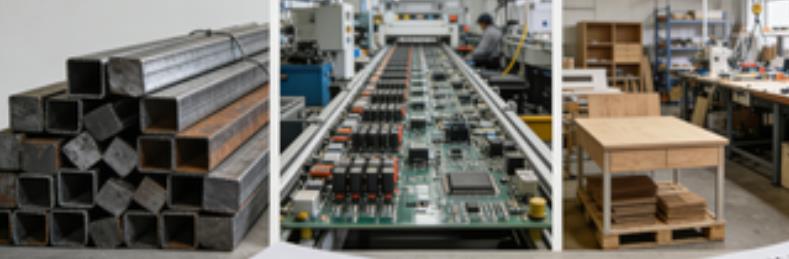
It’s a rainy February morning in Detroit, and my client Mark—owner of a small metal fabrication shop—stares at his email inbox in disbelief. The subject line from his steel supplier says it all: “2026 Price Increase: +25% Due to New Tariffs.” Mark’s hands clench as he opens the message; he’s already struggling with rising labor costs, and this new tariff hike will add $75,000 to his annual expenses. “I thought the steel tariffs were settled years ago,” he mutters, scrolling through the supplier’s explanation of Trump’s 2026 Section 232 tariff extension. Across the country in Portland, Sarah—who runs an e-commerce store selling budget electronics—gets a similar shock: Her Chinese supplier is raising prices 30% to cover the new 25% tariff on semiconductor chips like Nvidia’s H200. And in Charlotte, Mike—owner of a furniture wholesale business—breathes a temporary sigh of relief when he learns the planned 50% tariff on kitchen cabinets has been delayed, but he’s still stuck paying 25% on his imported sofas. I’ve spent the past 9 years walking business owners through tariff chaos, and 2026 is shaping up to be one of the most volatile years yet. Between Supreme Court rulings, Section 232 investigations, and last-minute policy U-turns, the rules are changing faster than most businesses can keep up. Today, I’m breaking down the 2026 tariff changes for steel, electronics, and furniture—with real stories from clients who’ve already felt the pinch, hard data on cost impacts, and actionable strategies to keep your profits intact. Because when tariffs jump 10-25% overnight, the difference between surviving and thriving is knowing what’s coming—and how to adapt.
First, let’s set the stage for 2026’s tariff chaos. It all started in February 2026, when the U.S. Supreme Court struck down Trump’s broad reciprocal tariffs under the International Emergency Economic Powers Act, calling them unconstitutional. Instead of backing down, Trump responded by announcing a 15% “global tariff” on most imports—then doubled down with Section 232 tariffs (for “national security”) on key industries like steel, aluminum, and semiconductors. The result? A patchwork of tariff hikes, delays, and exemptions that’s leaving business owners scrambling. The worst part? According to a study by Germany’s Kiel Institute for the World Economy, 96% of these tariff costs fall on U.S. importers and consumers—not foreign exporters. That means when the government raises tariffs on steel, it’s not Chinese mills paying the price—it’s American businesses like Mark’s and the customers who buy their products. That’s the harsh reality of 2026’s tariff policy: It’s a tax on U.S. businesses, plain and simple.
Steel & Aluminum: 25% Tariffs Are Back (With a Vengeance)
For anyone in manufacturing, construction, or metalworking, 2026’s steel and aluminum tariffs are a nightmare come true. After a brief period of uncertainty following the Supreme Court ruling, Trump reaffirmed the 25% tariff on all imported steel and 10% on aluminum under Section 232—with no exemptions for Canada or Mexico this time (though USMCA-compliant products get a pass). For Mark’s metal fabrication shop in Detroit, this has been catastrophic. He imports 300 tons of steel annually to make custom parts for the auto industry; before 2026, he paid $1,000 per ton, with a 10% tariff—$30,000 total in tariffs. Now, with the 25% tariff, that’s $75,000 in tariffs alone, plus the supplier’s price hike to cover their own costs. “I had to raise my prices 18% on all orders,” Mark told me, rubbing his temples. “Two of my biggest clients switched to a Canadian fabricator who doesn’t face the same tariffs. I’m losing $120,000 a year in revenue because of this.” Mark’s story isn’t unique—I have a client in Chicago who makes aluminum siding; his tariff costs went from $15,000 to $37,500, forcing him to lay off two employees.
But the pain isn’t limited to small businesses. A mid-sized construction company in Dallas I work with imports 1,500 tons of steel for commercial projects. Their 2026 tariff bill jumped from $150,000 to $375,000. “We bid on a school project last month and lost because we couldn’t compete with a firm that uses domestic steel,” their CFO told me. “But domestic steel costs 30% more than imported steel was before the tariff—so either way, we’re squeezed.” The worst part? The tariffs aren’t even working as intended. The goal of Section 232 tariffs is to boost domestic steel production, but U.S. steel mills can’t keep up with demand—they’re operating at 85% capacity, and building new mills takes years. That means businesses like Mark’s can’t switch to domestic suppliers even if they want to—they’re stuck paying higher prices for imported steel or waiting months for domestic deliveries.
The cost impact ripples through the entire supply chain. A client in Atlanta who makes steel shelving for retail stores told me he’s seen a 22% increase in raw material costs, which he’s passed on to retailers. Those retailers, in turn, are raising prices for consumers—so a $200 steel shelving unit now costs $244. “Consumers think it’s greedy corporations raising prices,” he said, “but we’re just passing along the tariff costs. The government says these tariffs are for national security, but they’re just making everyone poorer.” According to the Kiel Institute study, every $1 billion in steel tariffs costs U.S. consumers $1.2 billion in higher prices. For 2026’s $20 billion in steel tariffs, that’s $24 billion in added costs for American households.
Electronics: 25% Tariffs on Semiconductors (Nvidia, AMD Hit Hard)
If you’re in the electronics business—whether you sell laptops, AI hardware, or consumer gadgets—2026’s semiconductor tariffs are a make-or-break issue. In January 2026, the White House announced a 25% tariff on imported semiconductors, including Nvidia’s H200 chip and AMD’s MI325X AI accelerator. The rationale? “National security”—the government claims U.S. reliance on foreign semiconductors is a risk. But for businesses like Sarah’s e-commerce store in Portland, this tariff is a death sentence for her budget electronics line. She sells affordable laptops that use Nvidia’s H200 chip; before 2026, she paid $800 per laptop from her Chinese supplier, with a 5% tariff—$40 per unit. Now, with the 25% tariff, that’s $200 per unit in tariffs, plus the supplier’s 15% price hike. “I had to raise my laptop prices from $1,200 to $1,500,” Sarah said, fighting back tears. “My sales dropped 40% in the first month. People don’t want to pay $300 more for a budget laptop.”
The pain is even worse for businesses that rely on AI chips. A client in San Francisco who builds AI-powered inventory management systems uses 500 Nvidia H200 chips annually. His tariff costs went from $25,000 to $125,000—an extra $100,000 a year. “We had to put our expansion plans on hold,” he told me. “We were going to hire 10 new engineers, but now we can’t afford it. The tariff is like a tax on innovation.” The worst part? The tariffs don’t apply to data center or R&D use—only to consumer and commercial products. That means big tech companies like Google and Amazon get a pass, while small businesses get hit with the full 25% tariff. “It’s a double standard,” Sarah said. “Amazon can import thousands of chips tax-free for their data centers, but I have to pay 25% for chips in consumer laptops. How is that fair?”
The supply chain disruptions are equally bad. A client in Seattle who repairs electronics told me he’s struggling to get replacement semiconductors. “My supplier used to ship parts in 7 days; now it’s 3-4 weeks,” he said. “They’re prioritizing big clients who can pay the tariff, so small repair shops like mine are left waiting. I’ve lost $15,000 in revenue from delayed repairs.” And it’s not just semiconductors—Trump’s administration is also considering Section 232 tariffs on telecom equipment and power grid devices, which would hit businesses that sell routers, servers, and industrial electronics. For electronics businesses, 2026 is all about survival—finding alternative suppliers, renegotiating contracts, or passing costs to consumers.
Furniture: 25% Tariffs Stay (50% Hike Delayed—For Now)
Furniture importers got a mixed bag in 2026: The 25% tariff on soft furniture, kitchen cabinets, and bathroom vanities stayed in place, but the planned hike to 50% was delayed until 2027 due to public outcry over rising inflation. For Mike’s furniture wholesale business in Charlotte, this was a temporary reprieve—but he’s still feeling the pinch. He imports 1,000 soft sofas annually from Vietnam; before 2025, he paid a 7% tariff—$35,000 total. Now, with the 25% tariff, that’s $125,000 in tariffs. “I used to make a $200 profit per sofa,” Mike said. “Now it’s $80. I had to cut my marketing budget in half and stop attending trade shows.” Mike’s biggest concern is the 2027 deadline—if the tariff jumps to 50%, his profit per sofa will drop to $0, and he’ll have to stop importing soft furniture altogether.
The cost impact is hitting consumers hard, too. A client in Miami who owns a furniture retail store told me she’s raised prices 20% on imported sofas. “A $1,500 sofa now costs $1,800,” she said. “My customers are complaining, but I have no choice. If I don’t raise prices, I’ll lose money on every sale.” According to the National Retail Federation, furniture prices have already risen 12% in 2026 due to tariffs, and they’re expected to rise another 15% if the 50% tariff goes into effect. For middle-class families, this means delaying furniture purchases or settling for lower-quality products. “I had a customer who wanted to buy a new dining set for her home,” the Miami retailer said. “She saw the price and decided to keep her old set for another year. Tariffs are making furniture a luxury item again.”
The delay in the 50% tariff has given some businesses time to adapt. Mike is now sourcing 30% of his furniture from domestic manufacturers, even though it costs 15% more. “It’s better to pay a little more now than get hit with 50% tariffs later,” he said. He’s also renegotiating his contract with his Vietnamese supplier to include a tariff-sharing clause—they split the 25% tariff cost, which saves him $62,500 a year. But not all businesses are so lucky. A small furniture importer in Boston I work with couldn’t afford to switch to domestic suppliers or renegotiate contracts—she had to close her business in March 2026, putting 12 employees out of work. “The tariffs were the final straw,” she told me. “I was barely breaking even before, and now I can’t compete.”
How to Survive (And Thrive) in 2026’s Tariff Chaos
Now, let’s get to the actionable strategies—because knowing about tariff changes isn’t enough; you need to know how to protect your business. The first step is to audit your supply chain. Mark, the steel fabricator in Detroit, did this and found that 40% of his steel imports could be replaced with USMCA-compliant steel from Mexico—which is exempt from the 25% tariff. He now sources 120 tons of steel from Mexico, saving $30,000 in tariffs annually. “I had to switch suppliers and adjust my shipping schedule, but it was worth it,” he said. “I even got a better price from the Mexican supplier than my old Chinese supplier.” The key is to look for exemptions—USMCA, GSP, or Section 232 exclusions—and see if your products qualify.
Another strategy is to renegotiate contracts with suppliers. Sarah, the electronics seller in Portland, did this with her Chinese supplier. She agreed to increase her order volume by 20% in exchange for the supplier absorbing 10% of the tariff cost. “It was a win-win,” she said. “The supplier gets more business, and I save $80 per laptop. I can keep my prices competitive and still make a profit.” You can also ask for longer payment terms or fixed-price contracts to avoid future price hikes. Mike, the furniture wholesaler, got a 12-month fixed-price contract with his Vietnamese supplier, which protects him from tariff increases until 2027.
If you can’t avoid the tariffs, pass costs to consumers strategically. Don’t raise prices overnight—phase them in over 3-6 months and communicate openly with customers. The Miami furniture retailer did this by sending an email to her customers explaining the tariff changes and why prices were increasing. “Most customers understood,” she said. “They’d heard about the tariffs on the news, so it wasn’t a surprise. I even offered a 10% discount for pre-orders before the price hike, which boosted sales.” You can also bundle products or add value to justify higher prices—Sarah started including free accessories (laptop bags, mouse pads) with her laptops to make the $1,500 price tag more appealing.
For high-tariff products, consider shifting production to the U.S. or a tariff-exempt country. A client in Chicago who makes aluminum siding did this by opening a small production facility in Michigan. He now sources 60% of his aluminum domestically, saving $22,500 in tariffs annually. “It was a big investment—$150,000 to open the facility—but it will pay for itself in two years,” he said. If opening a U.S. facility is too expensive, consider countries with free trade agreements with the U.S., like Costa Rica or Singapore, which are exempt from most tariffs.
Finally, stay informed and plan ahead. Tariff policies are changing fast in 2026—what’s true today might not be true tomorrow. Subscribe to the U.S. International Trade Commission’s HTS updates (they release revisions every 6 months), follow trade news from the Wall Street Journal or Bloomberg, and work with a customs broker or trade attorney who specializes in tariffs. My clients who have a trade attorney on retainer have saved thousands—they’re the first to know about exemptions, tariff delays, or policy changes. “My attorney told me about the USMCA exemption for Mexican steel two weeks before it was announced,” Mark said. “I was able to switch suppliers before the tariff hike, while my competitors were caught off guard.”
Debunking 2026 Tariff Myths
Let’s set the record straight on some common myths about 2026’s tariffs. Myth #1: “Tariffs are paid by foreign exporters.” False. As the Kiel Institute study proved, 96% of tariff costs are passed to U.S. importers and consumers. Foreign exporters don’t lower their prices to absorb tariffs—they raise them, or U.S. businesses have to pay the tariff directly. Myth #2: “Tariffs will bring jobs back to the U.S.” So far, it’s not happening. The steel industry has added only 5,000 jobs since the 25% tariff was reimposed, while 15,000 jobs have been lost in industries that use steel (like manufacturing and construction). Myth #3: “Small businesses are exempt from tariffs.” No—tariffs apply to all importers, regardless of size. Small businesses are hit the hardest because they don’t have the resources to switch suppliers or absorb costs. Myth #4: “Tariffs are temporary.” Trump’s administration has signaled that these tariffs are here to stay—Section 232 tariffs can be renewed indefinitely, and the 15% global tariff is set to last 150 days with possible extensions. Don’t bet on tariffs going away anytime soon.
The Bottom Line: Adapt or Perish
2026’s tariff changes for steel, electronics, and furniture are a wake-up call for U.S. businesses. The days of cheap imported goods are over—at least for now. But businesses that adapt—by auditing their supply chains, renegotiating contracts, passing costs strategically, or shifting production—will survive and even thrive. Mark, the steel fabricator, is now more profitable than before because he found USMCA-compliant suppliers and raised prices strategically. Sarah, the electronics seller, increased her order volume and added value to her products, keeping her customer base intact. Mike, the furniture wholesaler, is diversifying his supply chain and planning for the 2027 tariff hike.
The key is to stop panicking and start planning. Tariffs are a tax, but they’re also an opportunity to optimize your business. Look for inefficiencies in your supply chain, renegotiate contracts, and communicate with your customers. And don’t go it alone—hire a trade attorney or customs broker who can help you navigate the complex world of 2026 tariffs.
I’ve seen businesses fail because they ignored tariff changes, and I’ve seen businesses grow because they embraced them as a catalyst for change. 2026 is a tough year for importers, but it’s not a death sentence. With the right strategies and a proactive mindset, you can protect your profits, keep your customers happy, and even grow your business.
If you’re struggling with 2026’s tariff changes—whether you’re a steel fabricator, electronics seller, furniture importer, or something in between—drop a comment below. Include your industry, the products you import, and the tariffs you’re facing, and I’ll help you craft a personalized strategy. No jargon, just real advice from someone who’s helped hundreds of businesses survive tariff chaos.
P.S. Don’t forget to grab the latest 2026 HTS revision from the U.S. International Trade Commission—it’s the most up-to-date resource for tariff rates and product classifications. It’s free, and it could save you thousands in unexpected tariff costs.
Leave a Reply