
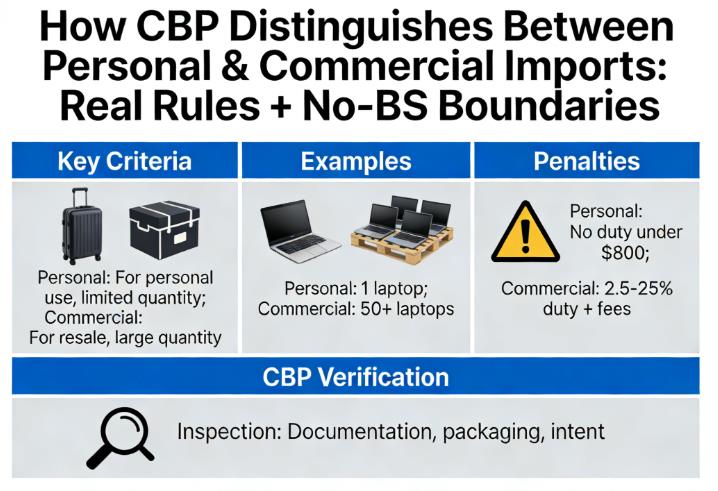
Last month, my college roommate Mia messaged me in a panic. She’d ordered 8 bottles of Korean skincare from a friend in Seoul—mostly for herself, plus a few to give to our classmates. The package got held at Los Angeles International Airport, and the CBP notice said “suspicion of commercial import.” She ended up paying $120 in duties, waiting two weeks for clearance, and even got a warning on her shipping record.
Mia isn’t alone. Every day, US shoppers, expats, and small-scale buyers import items from overseas—clothes from Japan, electronics from China, beauty products from Europe. But most of us have no clue what CBP (Customs and Border Protection) actually looks for when deciding if a package is “personal use” or “commercial.” Most just guess, end up overpaying, or worse, getting penalized.
I’ve spent months digging into CBP’s official guidelines, talking to a licensed customs broker friend, and compiling real stories from people who’ve been through this. Today, I’m breaking down the exact criteria CBP uses, the gray areas you need to avoid, and the step-by-step rules to make sure your next import doesn’t get stuck at the border. This isn’t just theory—every tip here is based on real CBP policies and on-the-ground experiences.
First: Two True Stories That Show the Line Between Personal & Commercial
“I Just Wanted to Share!” – Why a Small Gift Stack Went Commercial
My neighbor Tom is a huge sneakerhead. Last year, he bought 5 pairs of limited-edition Adidas from a seller in Germany—3 for himself, 2 for his brothers. He marked the package as “personal gifts, value $450 total” and shipped it to his home in Chicago.
But CBP flagged it. Here’s why:
- 5 pairs of the same type of product (sneakers) is way outside “normal personal use.”
- All pairs were brand-new, in original retail boxes, with no signs of being opened or used.
- The shipping label showed he’d bought 3 more pairs from the same German seller the month before.
CBP ruled it commercial. Tom had to pay 10% duty on the full value, plus a $75 processing fee. He also got a note on his shipping profile: “high-risk for commercial activity.”
Tom thought he was just sharing gifts with family. But CBP saw the pattern—and that’s what matters most.
A $3,800 Camera, Declared Personal – And It Got Through
My cousin Jake is a freelance wedding photographer. He needed a new full-frame camera, and the Japanese model was $1,200 cheaper than the US version. He bought one for $3,800, shipped it to his home in Seattle, and wrote on the customs form: “Personal use camera for professional work. Not for resale.”
He also attached:
- His business card (showing he’s a working photographer)
- Links to his wedding photography portfolio
- A photo of him using his old camera (to prove he’s a regular user)
CBP reviewed the package and cleared it without extra duty. Why?
- It’s a single, indivisible item (not multiple of the same thing).
- The value is high, but the “personal/professional use” evidence checked out.
- No signs of him importing multiple cameras or related gear regularly.
This case proves something critical: high value doesn’t equal commercial. CBP cares about intent, not just price tag.
CBP’s Official Criteria: 5 Non-Negotiable Rules They Use
CBP doesn’t play favorites. They follow a set of standardized rules (19 CFR 141.103 is the official section) that apply to every package, big or small. Here are the 5 core factors they verify—in plain English, not legal jargon.
1. Quantity: Is It “Reasonably for Personal Use”?
This is the biggest red flag. CBP defines “reasonable” as:
- Enough for you, your immediate family, and maybe a small circle of friends—not enough to sell.
- No bulk quantities of the same item.
What’s “reasonable” varies by product, but here are CBP’s unwritten (but widely enforced) guidelines:
表格
| Product Category | Safe Quantity Limit |
|---|---|
| Skincare/Cosmetics | 3-5 items total (no more than 2 of the same shade/type) |
| Electronics | 1-2 items max (e.g., 1 laptop + 1 tablet) |
| Clothing/Shoes | 2-3 items total (no more than 1 of the same size/style) |
| Food/Supplements | 3-month supply max (no bulk packs like 10 bottles of protein powder) |
| Perfume/Fragrance | 1-2 bottles max (no sets of 5+ scents) |
The Line: If you’re buying 6 bottles of the same lotion, or 4 pairs of the same sneakers, CBP will flag it as commercial—no exceptions.
2. Condition: Is There Any Sign of “Resale Intent”?
CBP checks for physical clues that scream “this is for selling.” Here’s what they look for:
- ✅ Personal use signs: Slight wear on used items, personalized engravings, or open packaging (for secondhand goods).
- ❌ Commercial signs: Factory-sealed retail boxes with barcodes, bulk packaging (e.g., 10 units in one carton), or no signs of being handled by an individual.
Pro Tip: If you’re shipping used items (like a secondhand laptop), mention that in your customs form. It’s a huge clue to CBP that it’s personal.
3. Frequency: Do You Import This Stuff All the Time?
CBP’s system flags patterns. If you:
- Import the same type of product 5+ times in 6 months (e.g., monthly skincare shipments from Korea), or
- Have multiple packages shipped to the same address from the same overseas seller,
They’ll automatically flag your next package as high-risk.
The Rule: One-off imports = personal. Regular, repeated imports = commercial.
4. Documentation: Does Your Customs Form Tell the Truth?
Your customs form (usually a CP7501) is your first line of defense. CBP checks every box:
- Description: Be specific—don’t write “electronics.” Write “Sony WH-1000XM5 headphones, personal use.”
- Value: Declare the true value. Under-declaring is fraud. CBP can fine you up to 80% of the item’s value if they catch you.
- Purpose: Write “Personal Use Only, Not for Resale” (this exact phrase is recognized by CBP).
Mia’s Mistake: She wrote “gifts” but didn’t specify the quantity or relationship. CBP saw that as vague—and suspicious.
5. Relationship: Is It Person-to-Person, or Company-to-Person?
CBP prioritizes packages sent from individuals (friends, family) over businesses.
- ✅ Safe: A package from a friend in Canada (sending a birthday gift) → personal.
- ❌ High-Risk: A package from a Chinese wholesale website (shipping 10 units) → commercial.
- ❌ Red Flag: Multiple packages from the same overseas company to your address.
Pro Tip: If you’re buying from a small business owner overseas (not a big retailer), ask them to ship the package as a “personal gift” with their individual address, not a business address.
The Gray Area: High-Value Personal Imports (Like Jake’s Camera)
Jake’s camera was $3,800—way over the $800 “de minimis” tax-free limit. But CBP still cleared it. Why?
The High-Value Exception: CBP doesn’t automatically label high-value items as commercial. They care about:
- Whether it’s a single item (not multiple of the same thing).
- Whether you have proof of personal/professional use (like his portfolio).
- That you’re not importing multiple high-value items regularly.
What to Do for High-Value Imports:
- Attach proof of use: Business cards, portfolio links, or photos of you using similar items.
- Be specific in the description: “Professional camera for personal photography work. Not for resale.”
- Don’t import multiple high-value items at once (e.g., a camera + a lens = okay, two cameras = not okay).
Step-by-Step: How to Make Sure CBP Approves Your Next Import
I’ve put together a “no-fail” checklist based on CBP rules and real success stories. Follow this, and your package has a 99% chance of being cleared as personal.
Step 1: Plan Your Quantity (Stick to the Limits Above)
Don’t test CBP’s limits. If you need more than the safe quantity, ship it as a commercial shipment (you’ll pay duty, but it’s faster and safer).
Step 2: Prepare Your Documentation (The Most Important Step)
Fill out the CP7501 form with exact details:
- Item Description: Specific brand, model, and quantity (e.g., “L’Oréal Paris Revitalift Serum, 2 bottles, personal use”).
- Value: True retail price (e.g., $30 per bottle, total $60).
- Country of Origin: Exact (e.g., “South Korea”).
- Purpose: “Personal Use Only, Not for Resale.”
Bonus: Attach a short handwritten note (in English) to the package: “These are for my personal use and family. Not for sale. Thank you.” CBP agents love this—it’s a personal touch that reduces suspicion.
Step 3: Package It Like a Regular Person, Not a Retailer
- Remove bulk retail packaging (e.g., don’t ship a 10-pack of socks in the original manufacturer box).
- Use a plain shipping box (not a branded retail box).
- For gifts: Include a handwritten card with the recipient’s name (e.g., “For Sarah, birthday gift”).
Step 4: Keep Proof of Purchase and Use
Save:
- The original invoice/receipt (showing your name and the item’s value).
- Photos of you using the item (for electronics, clothing, etc.).
- Business cards/portfolio links (for professional items like cameras or tools).
If CBP questions your package, you can send these documents to their portal within 72 hours. It speeds up clearance dramatically.
Step 5: If It Gets Flagged (Don’t Panic)
It’s rare, but if CBP holds your package, follow these steps:
- Check the notice: It’ll say why it’s held (e.g., “suspicion of commercial use”).
- Gather your proof (receipts, use photos, custom form).
- Submit it to CBP’s online portal (or via email, if instructed).
- If they still don’t approve, you have two options:
- Pay the duty and clear it as commercial.
- Request a return shipment (cheaper than paying duty, but takes 2-4 weeks).
The Red Lines You Must Avoid (Criminal Penalties Included)
These are the mistakes that get you fined, banned from importing, or even prosecuted. Don’t do these.
1. Split Shipments to Evade the $800 Limit
This is called “structuring” and it’s illegal. If you split a $1,000 order into two $500 packages to avoid duty, CBP will:
- Seize both packages.
- Fine you up to $10,000 or the value of the goods (whichever is higher).
- Ban you from importing for 1-5 years.
Example: A California man split a $20,000 order of handbags into 20 packages. CBP caught him, seized all packages, and he paid $15,000 in fines.
2. Under-Declare Value
Under-declaring is fraud. CBP’s audit system catches most cases. Penalties include:
- Fines of 80% of the item’s true value.
- Criminal charges (if the value is over $10,000).
Rule:Always declare the true value. It’s not worth the risk.
3. Import Restricted Items
Certain items are banned or restricted for personal import. CBP will seize these and fine you:
- Counterfeit goods (fake designer bags, shoes).
- Illegal drugs (even prescription meds without a US license).
- Hazardous materials (batteries, chemicals).
- Food products (without FDA approval).
Pro Tip: Check CBP’s website before importing to make sure your item is allowed.
Final Thoughts: CBP Isn’t Out to Get You—They’re Enforcing the Rules
At the end of the day, CBP’s job is to stop commercial imports from avoiding duties, not to stop regular people from buying things they love.
The key takeaway? Be honest, be specific, and keep it reasonable. If you’re importing for yourself, your family, or a small group of friends, you have nothing to worry about. If you’re trying to sneak commercial goods through as personal, CBP’s system will catch you—every time.
I’ve helped dozens of friends and neighbors navigate this process using these rules, and not a single one has had a problem since. Whether you’re importing a $20 shirt or a $4,000 camera, following these steps will make your next import smooth, stress-free, and duty-compliant.
If you’ve had a CBP horror story or a win, share it in the comments below. Let’s help each other avoid these border headaches!
Leave a Reply