
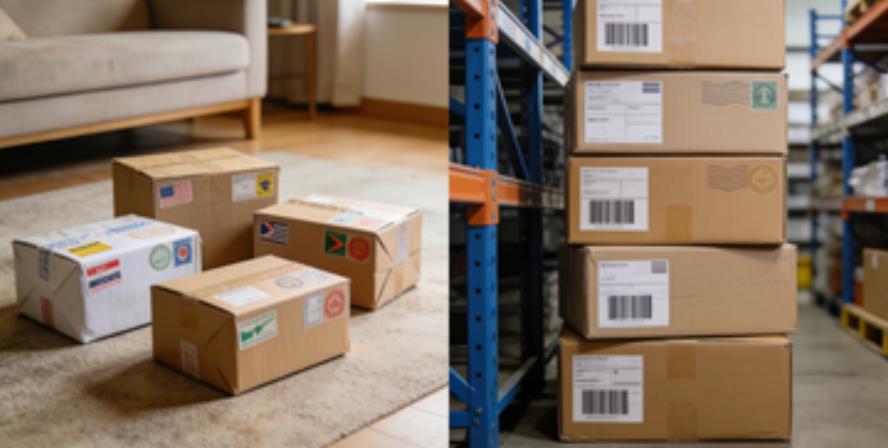
It’s a Tuesday evening, and I’m on a video call with two friends—both navigating the import world, but in totally different lanes. Sarah is a busy mom who orders skincare from Korea and home decor from Japan for personal use; Mike runs a small Shopify store selling artisanal tea from Taiwan, shipping 50-70 packages a month to U.S. customers. Sarah’s latest haul got held at JFK Airport for “declaration discrepancies,” while Mike just got a $2,300 fine from CBP for using the wrong customs form. As they vent, I realize they’re making the same mistake so many people do: confusing personal hauler rules with small e-commerce import regulations.
This guide isn’t just a dry comparison of forms and fees—it’s the clarity I wish I’d had when I started as a small-scale importer (and yes, I once made the mistake of using a personal declaration for commercial goods, costing me $1,800 in penalties). We’re diving into the real-world differences between personal and commercial 报关 (customs declaration), the specific scenarios where each applies, the costly mistakes that get you flagged, and how to stay compliant whether you’re importing for your own closet or building a small business. If you’re ordering a few items for yourself or selling to U.S. consumers, this will save you from delays, fines, and the headache of explaining yourself to CBP.
First, let’s get the core distinction straight: CBP treats personal imports and commercial imports as two entirely separate categories, with different rules, forms, and penalties. Personal hauls are for non-commercial use—items you plan to keep, use, or give as gifts (not sell). Small e-commerce imports are for commercial use—items you intend to resell for profit, even if you’re a one-person operation. In 2026, CBP is cracking down harder than ever on “commercial imports disguised as personal hauls” (a trick many small sellers use to avoid fees and paperwork), with fines up to $10,000 per violation and even seizure of goods. The line between personal and commercial isn’t always blurry—but when it is, CBP errs on the side of enforcing commercial rules.
Personal Haul Customs: Rules, Limits, and How to Declare Correctly
Sarah’s story is relatable to anyone who’s ever clicked “checkout” on an international website. She ordered $600 worth of skincare, sheet masks, and a few decorative bowls from a Korean marketplace, checked the box labeled “personal use” at checkout, and assumed that was it. Three weeks later, she got a letter from CBP saying her package was held because the declared value exceeded the personal exemption limit, and she needed to pay duties plus a $150 processing fee. She was confused—she’d ordered similar items before with no issues. What changed? In 2026, CBP tightened enforcement of personal exemption rules, and she’d unknowingly crossed a threshold.
Personal hauls fall under two categories: “informal entries” and “formal entries,” based on value. For most countries, the de minimis value (the amount below which no duties or taxes are owed) is $800. That means if your personal shipment is worth $800 or less, it qualifies as an informal entry—no duties, no complex paperwork, just a simple declaration of contents and value. But there’s a catch: the items must be for personal use, and you can’t import large quantities that suggest resale. Sarah’s mistake? Her shipment was $600 (under $800), but she’d ordered 20 sheet masks, 10 bottles of serum, and 5 bowls—quantities that CBP deemed “excessive for personal use.” They suspected she was reselling the items, so they classified it as a commercial entry and charged her duties.
I learned this lesson back in 2023, when I ordered 15 pairs of socks from a Japanese brand I loved (I have a weird obsession with quirky socks). The total value was $220 (well under $800), but CBP held the package because 15 pairs were considered “more than a reasonable amount for personal use.” I had to send photos of my sock drawer (yes, really) to prove I wasn’t reselling them, and it took a week to get the package released. Now, I limit personal orders to quantities that make sense—3-5 of any item, max. CBP’s logic is simple: if you’re buying enough to stock a shelf, it’s not personal.
Another rule for personal hauls: you can’t import restricted or prohibited items, even if they’re for personal use. This includes things like certain medications (e.g., unapproved skincare with prescription ingredients), plant products (e.g., fresh flowers or unprocessed herbs), and counterfeit goods. I had a cousin try to import a “designer-inspired” handbag for personal use—CBP seized it as counterfeit, and she never got it back (or a refund from the seller). Even if you don’t know an item is prohibited, ignorance isn’t an excuse—CBP expects you to research before ordering.
Declaring personal hauls correctly is straightforward, but attention to detail matters. When filling out the customs form (usually provided by the seller or shipping carrier like DHL, FedEx, or USPS), be specific about the contents. Instead of “miscellaneous items,” write “5 sheet masks, 2 facial serums, 3 decorative ceramic bowls—personal use only.” Include the exact value (use the invoice amount, not a rounded number), and never lie about the contents or value. Underdeclaring to avoid duties is illegal, and CBP cross-references prices with market data—if you say a $200 serum is worth $50, they’ll catch it.
Small E-Commerce Import: Customs Rules for Resale Goods
Mike’s story is a cautionary tale for small business owners who treat commercial imports like personal hauls. He started selling Taiwanese tea online as a side hustle, importing 10-15 pounds of tea every month. He used the same customs form as personal shipments, checked “personal use,” and declared the value as “gift” to avoid fees. After six months of this, CBP flagged his shipments (they track repeat imports from the same sender/receiver), audited his records, and hit him with a $2,300 fine for misdeclaration. He also had to pay back duties on all his previous shipments, totaling another $1,200. “I just thought it was easier to check ‘gift,’” he told me. “I had no idea it was illegal.”
Small e-commerce imports are commercial entries, regardless of value. Even if your shipment is worth $100, if you plan to resell the items, you must declare it as commercial. This means more paperwork, duties (depending on the product), and compliance with U.S. regulations like labeling (e.g., country of origin, ingredient lists for food items) and product safety standards (e.g., FDA approval for food and cosmetics). The key form for small e-commerce imports is the Commercial Invoice, which must include detailed information: seller’s name and address, buyer’s name and address (your business), description of goods (specific, not vague), quantity, unit value, total value, HTS code, and a statement that the goods are for resale.
I made the mistake of using a personal declaration for my first commercial shipment—50 bamboo toothbrushes I planned to sell on Etsy. The value was $300 (under $800), so I thought I could get away with it. CBP held the shipment, classified it as commercial, charged me $45 in duties, and a $150 processing fee. The delay cost me two weeks of sales, and I learned my lesson: commercial imports require commercial paperwork, no exceptions. Now, I work with a small customs broker who helps me fill out the Commercial Invoice and ensure compliance—worth every penny to avoid fines.
Duties for commercial imports vary by product, based on the HTS code. For example, tea falls under HTS code 0902.10, with a duty rate of 3.5%; bamboo toothbrushes are under 4421.99, with a duty rate of 6.5%. You can look up HTS codes on the CBP website (hts.usitc.gov) or ask your supplier for the correct code. Using the wrong HTS code is another common mistake—Mike initially used a code for “agricultural products” instead of “tea,” which led to a higher duty rate and suspicion from CBP.
Another requirement for small e-commerce imports is product labeling. If you’re selling food items (like tea), you need FDA-compliant labels with ingredient lists, country of origin, and expiration dates. If you’re selling cosmetics, you need labels with ingredient lists and safety warnings. I once ordered a batch of handmade soap from a French artisan to sell online—CBP held the shipment because the labels didn’t include English translations of the ingredients. I had to pay the supplier to send new labels, which took two weeks and cost me $200. Now, I require all suppliers to provide FDA-compliant labels before shipping.
The Big Mistakes That Get You Fined (And How to Avoid Them)
The line between personal and commercial imports is where most people get into trouble. CBP’s biggest red flag is commercial imports disguised as personal hauls—and they’re getting better at catching it in 2026, thanks to AI tools that track repeat shipments, quantities, and values. Here are the most common mistakes I’ve seen (and made) and how to steer clear.
First mistake: Using “personal use” or “gift” for commercial goods. This is the #1 violation for small e-commerce sellers. Mike did this, and so did I—we thought it was a harmless shortcut, but CBP sees it as fraud. If you plan to resell an item, declare it as commercial, even if it’s a single unit. The penalties for misdeclaration are steep: fines starting at $1,000, back duties, and even seizure of goods. I know a seller who had a $5,000 shipment of jewelry seized because she declared it as a personal gift—she never got the jewelry back, and the fine was $3,000.
Second mistake: Excessive quantities in personal hauls. As Sarah and I learned, even if your shipment is under $800, buying too many of the same item will trigger suspicion. CBP doesn’t have a strict quantity limit, but they use “reasonable for personal use” as a guideline. A good rule of thumb: no more than 5 of any single item for personal imports. If you need more (e.g., you’re buying gifts for a large family), include a note explaining the purpose—e.g., “10 scarves for Christmas gifts for family members.”
Third mistake: Underdeclaring or misdeclaring value. Whether it’s personal or commercial, lying about the value of your shipment is illegal. CBP cross-references your declared value with invoices, market prices, and even the seller’s website. I had a friend import a $1,200 laptop for personal use and declare it as $300 to avoid duties—CBP found the actual price on the seller’s site, fined him $800, and made him pay duties on the full $1,200. It’s never worth the risk—declare the exact transaction value.
Fourth mistake: Ignoring product regulations for commercial imports. Small e-commerce sellers often skip steps like FDA approval for food items or CPSIA labels for children’s products, thinking “small business” means “exempt.” That’s not true. CBP works with other agencies (FDA, FTC, CPSC) to enforce product safety rules. I know a seller who imported children’s toys without CPSIA labels—CBP seized the entire shipment, and she had to destroy the toys (costing her $4,000) because they couldn’t be relabeled.
Compliance Guide: How to Avoid Penalties (For Personal and Commercial Imports)
Staying compliant doesn’t have to be complicated—it’s about understanding the rules, being transparent, and documenting everything. Here’s the system I use for both personal and commercial imports, honed after years of mistakes and close calls.
For personal hauls:
- Stick to the limits: Keep total value under $800 (to qualify for de minimis) and quantities reasonable (3-5 of any item). If you need more, split the order into multiple shipments (e.g., order 5 items now, 5 later) or include a note explaining the purpose.
- Be specific on declarations: List each item with details (e.g., “2 bottles of facial moisturizer, 3 cotton scarves”) and the exact value. Never use vague terms like “miscellaneous” or “gift” unless it’s actually a gift from someone else (not a purchase).
- Research restricted items: Check CBP’s list of prohibited and restricted items before ordering. If you’re unsure, contact the carrier (DHL, FedEx) or CBP directly—better safe than sorry.
- Keep documentation: Save the order confirmation, invoice, and tracking number. If CBP has questions, you’ll need proof of purchase and intent.
For small e-commerce imports:
- Use the right paperwork: Always submit a Commercial Invoice with detailed information (product descriptions, quantities, values, HTS code, resale statement). If your shipment is worth over $2,500, you’ll need a formal entry (which requires a customs bond—more on that below).
- Get a customs bond: A continuous bond (good for a year) costs $500-$1,000 and is required for formal entries (value over $2,500) or if you import regularly. It guarantees CBP you’ll pay duties and comply with rules. I use a bond provider recommended by my customs broker—worth every penny to avoid delays.
- Comply with labeling and safety rules: Ensure your products have the required labels (country of origin, ingredients, safety warnings) and meet U.S. standards (FDA for food/cosmetics, CPSIA for kids’ products). Work with your supplier to get compliant labels before shipping.
- Work with a customs broker: If you’re new to commercial imports, a broker (cost: $100-$200 per shipment) will handle paperwork, HTS codes, and communication with CBP. They’ll save you time, money, and stress—Mike now uses a broker and hasn’t had a single issue since.
Real-World Stories: The Cost of Cutting Corners
I’ve collected dozens of stories from friends and fellow importers—here are two that highlight the difference between compliance and cutting corners.
First story: Lisa, a personal hauler who loved luxury skincare, ordered $750 worth of products from France—10 bottles of serum, 8 jars of cream, and 5 tubes of lipstick. She declared it as “personal use,” but CBP deemed the quantities excessive. They classified it as a commercial entry, charged her $180 in duties, and a $200 processing fee. The delay meant her favorite serum ran out, and she had to pay extra to get a replacement locally. Total cost of cutting corners: $380 plus inconvenience.
Second story: Jake, a small e-commerce seller who sold handmade candles from Mexico. He started with small shipments (worth $500-$1,000) and used a Commercial Invoice, got a continuous bond, and worked with a broker. Even when his shipments grew to $5,000+, he stayed compliant. In 2026, CBP did a random audit of his records—because his paperwork was complete and accurate, they cleared him with no issues. He’s never had a shipment delayed or fined, and his business has grown 30% in a year. The lesson: compliance pays off in smooth shipments and peace of mind.
Final Thoughts: Personal vs. Commercial—Know the Line, Stay Compliant
The difference between personal and small e-commerce imports boils down to one thing: intent. If you’re buying for yourself, follow the personal rules—stick to limits, be transparent, and avoid excessive quantities. If you’re buying to sell, follow the commercial rules—use the right paperwork, get a bond, comply with regulations, and don’t try to pass off commercial goods as personal.
In 2026, CBP isn’t messing around with misdeclarations. They have AI tools to track repeat shipments, cross-reference values, and flag suspicious activity. The cost of cutting corners—fines, delays, seized goods, lost sales—is far higher than the time and money it takes to comply.
Whether you’re a personal hauler looking to avoid delays or a small business owner building a brand, the key is to educate yourself. Research the rules, ask questions (CBP has a help line: 1-877-CBP-5511), and don’t be afraid to invest in tools like customs brokers or bonds—they’ll save you from costly mistakes.
I’ve made my share of errors over the years—from 15 pairs of socks held by CBP to a commercial shipment fined for misdeclaration. But those mistakes taught me that compliance isn’t just about following rules—it’s about protecting your time, money, and sanity.
So the next time you click “checkout” on an international order, ask yourself: Is this for me, or for my business? Once you answer that, follow the corresponding rules. Your wallet (and your peace of mind) will thank you.
Here’s to smooth shipments, no fines, and stress-free importing in 2026!
Leave a Reply