
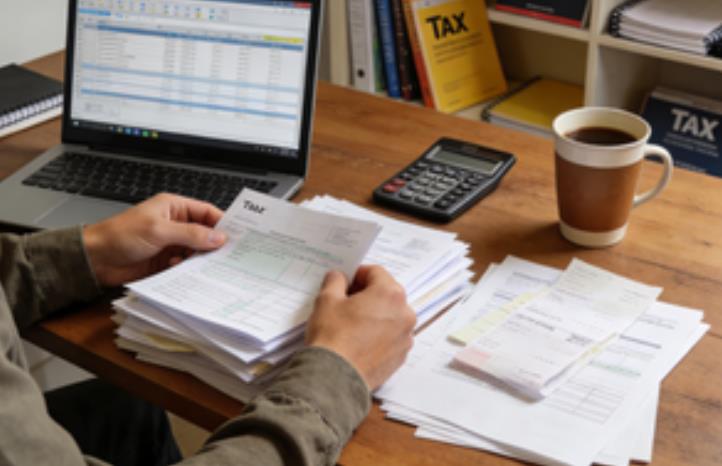
It’s a humid July evening in Nashville, and my client Jake— a freelance graphic designer pulling in $120,000 a year—slams his laptop shut, frustrated. He’d just finished his tax return and realized he owed $17,000 in self-employment tax alone, on top of income tax. “Why do I have to pay double what my salaried friends pay in Social Security and Medicare?” he groaned. Jake was right to be annoyed: self-employment tax (SE Tax) hits freelancers, independent contractors, and small business owners hard—15.3% of net self-employment income (12.4% for Social Security, 2.9% for Medicare), compared to the 7.65% salaried employees pay (with employers covering the other half). But what Jake didn’t know was that there are legal, IRS-approved ways to slash that bill—no tax evasion, no sketchy loopholes, just smart planning. After 8 years of helping self-employed professionals (graphic designers, consultants, photographers, contractors) lower their SE Tax burden, I’m breaking down three 实操 (actionable) strategies that actually work—with real stories, step-by-step examples, and brutal lessons from clients who overpaid for years. Because for self-employed folks, every dollar saved on SE Tax is a dollar you can reinvest in your business or keep in your pocket.
First, let’s get clear on what SE Tax is (and isn’t). SE Tax is the self-employed version of FICA taxes—Social Security and Medicare. If you’re self-employed and make $400 or more in net income, you’re required to pay it. The tax applies to your “net self-employment income,” which is your total business income minus allowable deductions (like office supplies, travel, or equipment). Jake’s mistake? He was only taking basic deductions—paper, software subscriptions, a few client meals—and had no idea he could structure his business or his expenses to reduce his SE Tax liability. I’ve seen self-employed clients overpay by $5,000-$10,000 a year just because they didn’t know these strategies existed. The first rule of SE Tax: It’s not just about deducting expenses—it’s about structuring your income and your business to minimize the amount of money subject to the 15.3% tax.
Strategy 1: Max Out a Solo 401(k) (The Most Powerful SE Tax Hack)
If you’re self-employed and don’t have any employees (other than a spouse), a Solo 401(k) is your SE Tax secret weapon. Here’s why: Contributions to a Solo 401(k) reduce your net self-employment income—meaning you pay SE Tax on a smaller amount, while also saving for retirement. Let’s break this down with Jake’s example. Before we worked together, Jake was contributing nothing to retirement, so his net self-employment income was $120,000—subject to the full 15.3% SE Tax ($18,360). We set up a Solo 401(k) for him, and he started contributing the maximum allowed: $23,000 in employee contributions (2024 limit for those under 50) plus 20% of his net self-employment income as employer contributions (the formula is a bit tricky—for self-employed individuals, the employer contribution is 20% of your net self-employment income after subtracting the employee contribution). For Jake, that meant an additional $19,400 in employer contributions, totaling $42,400 in annual Solo 401(k) contributions. His net self-employment income subject to SE Tax dropped from $120,000 to $77,600, cutting his SE Tax bill to $11,873—saving him $6,487 a year. That’s not chump change—Jake used that extra money to buy new design software, hire a part-time assistant, and take a much-needed vacation.
But Solo 401(k)s aren’t just for high earners. My client Maria, a part-time freelance writer in Portland making $60,000 a year, was paying $9,180 in SE Tax. She set up a Solo 401(k) and contributed $23,000 (employee contribution) plus $7,400 (employer contribution), totaling $30,400. Her net self-employment income subject to SE Tax dropped to $29,600, and her SE Tax bill fell to $4,529—saving her $4,651 a year. Maria used the savings to pay off credit card debt and invest in a website redesign that helped her land higher-paying clients. The key with Solo 401(k)s is to contribute as much as possible— the more you contribute, the lower your SE Tax liability, and the more you save for retirement. And unlike Traditional IRAs, Solo 401(k)s have much higher contribution limits (up to $69,000 in 2024 for those under 50, $76,500 if 50 or older), making them ideal for self-employed individuals who want to save big and lower their taxes.
The biggest mistake I see with Solo 401(k)s is waiting too long to set one up. My client Tom, a freelance photographer in Chicago, put off setting up a Solo 401(k) for three years because he thought it was “too complicated.” During those three years, he overpaid $18,000 in SE Tax. When we finally set it up, he realized how easy it was—most brokers (Vanguard, Fidelity, Charles Schwab) offer Solo 401(k) plans with no setup fees and minimal paperwork. He now contributes the maximum every year and jokes that his Solo 401(k) is his “best employee” because it saves him more money than any client pays him. Another mistake: Forgetting to make employer contributions. Unlike 401(k)s for employees, Solo 401(k)s require you to make employer contributions by the tax filing deadline (including extensions). My client Lisa, a freelance marketer in Miami, made her $23,000 employee contribution but forgot to make the employer contribution until after her tax deadline. She missed out on $8,000 in tax-advantaged savings and a $1,224 SE Tax reduction—don’t let that happen to you.
Strategy 2: Deduct Qualified Business Expenses (The “Hidden” SE Tax Savers)
Most self-employed individuals know to deduct obvious expenses—office supplies, travel, software—but they miss out on hundreds (or thousands) of dollars in deductions that can lower their net self-employment income and, in turn, their SE Tax. The key is to deduct every legitimate business expense—even the small ones—and to take advantage of “above-the-line” deductions that reduce your self-employment income before SE Tax is calculated.
Let’s start with home office deductions—one of the most underused SE Tax savers. If you use part of your home exclusively for business, you can deduct a portion of your rent, mortgage interest, utilities, internet, and even homeowners insurance. My client Mike, a freelance web developer in Austin, works out of a spare bedroom in his apartment. The room is 200 square feet, and his total apartment is 1,000 square feet—so he can deduct 20% of his rent ($1,200 a month), utilities ($200 a month), and internet ($80 a month). That’s $1,480 a month in deductions, or $17,760 a year. His net self-employment income dropped by $17,760, cutting his SE Tax bill by $2,717 a year. Mike was hesitant to take the home office deduction at first because he’d heard it was an “audit red flag,” but as long as you use the space exclusively for business (no working on the couch while watching TV), it’s a legitimate deduction the IRS encourages.
Another underused deduction: Health insurance premiums. Self-employed individuals can deduct 100% of their health insurance premiums (including dental and vision) as an above-the-line deduction, which reduces their net self-employment income. My client Sarah, a freelance yoga instructor in Denver making $80,000 a year, pays $12,000 a year for health insurance for herself and her family. Before she knew about this deduction, she was paying SE Tax on $80,000—$12,240. After deducting the $12,000 in health insurance premiums, her net self-employment income dropped to $68,000, and her SE Tax bill fell to $10,404—saving her $1,836 a year. Sarah also deducts her yoga instructor certification fees, workshop costs, and even the cost of her yoga mats and props—every little bit adds up.
Let’s talk about travel expenses—another big one for self-employed professionals who meet with clients or attend conferences. My client Dave, a freelance management consultant in Boston, travels frequently to meet with clients across the country. He deducts airfare, hotel stays, rental cars, client meals (50% deductible), and even the cost of dry cleaning his suits while on the road. Last year, he deducted $15,000 in travel expenses, which reduced his net self-employment income by $15,000 and saved him $2,295 in SE Tax. The key with travel expenses is to keep detailed records—save receipts, track mileage (67 cents per mile in 2024), and document the business purpose of each trip. Dave uses a free app called Expensify to scan receipts and track expenses, making tax time a breeze.
The biggest mistake with business expenses is not keeping records. My client Jen, a freelance event planner in Los Angeles, forgot to save receipts for $5,000 in event supplies and client meals. She couldn’t deduct those expenses, so she paid an extra $765 in SE Tax. Now she keeps a shoebox in her office for physical receipts and uses a spreadsheet to track digital purchases—she never misses a deduction now. Another mistake: Deducting personal expenses as business expenses. The IRS is cracking down on this, so make sure every deduction is directly related to your business. For example, you can’t deduct your entire cell phone bill if you use your phone for personal calls—only the portion used for business. My client Mark, a freelance videographer in Seattle, tried to deduct his entire $1,200 annual cell phone bill and got audited. He had to pay back $184 in SE Tax plus penalties—lesson learned.
Strategy 3: Restructure as an S-Corp (For High-Earners Ready to Scale)
If you’re self-employed and making $100,000 or more a year, restructuring your business as an S-Corporation (S-Corp) can save you thousands in SE Tax. Here’s why: As a sole proprietor or LLC taxed as a sole proprietor, you pay SE Tax on all your net self-employment income. As an S-Corp, you only pay SE Tax on the “reasonable salary” you pay yourself— the rest of your income is distributed as dividends, which are not subject to SE Tax. This is a game-changer for high-earning self-employed individuals, but it’s not for everyone—S-Corps require more paperwork, higher setup costs, and ongoing compliance (like holding annual meetings and keeping minutes).
Let’s use Jake’s example again to see how this works. Jake, the graphic designer making $120,000 a year, was paying $18,360 in SE Tax as a sole proprietor. We restructured his business as an S-Corp, and he paid himself a “reasonable salary” of $60,000 (the IRS requires S-Corp owners to pay themselves a salary that’s comparable to what someone else would earn for the same work). He paid SE Tax on the $60,000 salary ($9,180) and distributed the remaining $60,000 as dividends—no SE Tax on the dividends. That cut his SE Tax bill by $9,180 a year—almost half! Jake used the savings to hire a full-time assistant, move into a larger studio space, and invest in marketing that doubled his income the following year.
But S-Corps aren’t just for graphic designers. My client Dr. Emily, a self-employed physical therapist in Chicago making $180,000 a year, was paying $27,540 in SE Tax as a sole proprietor. She restructured as an S-Corp, paid herself a reasonable salary of $90,000 (SE Tax of $13,770), and distributed $90,000 as dividends. Her SE Tax bill dropped by $13,770 a year—saving her over $130,000 in 10 years. Dr. Emily used the savings to open a second clinic and hire two more therapists. The key with S-Corps is to pay yourself a “reasonable salary”—if you pay yourself too little, the IRS will reclassify your dividends as salary and hit you with back taxes and penalties. My client Tom, a freelance software developer in San Francisco, tried to pay himself a $30,000 salary from his $150,000 S-Corp income. The IRS audited him, reclassified $70,000 of dividends as salary, and he had to pay $10,710 in back SE Tax plus penalties. Now he pays himself a $90,000 reasonable salary and distributes the remaining $60,000 as dividends—safe and legal.
Another thing to consider with S-Corps is the setup and ongoing costs. Setting up an S-Corp costs $100-$500 (depending on the state), and you’ll need to file separate business tax returns (Form 1120-S), which can cost $1,000-$3,000 a year if you hire an accountant. But for high-earning self-employed individuals, the SE Tax savings far outweigh these costs. My client Lisa, a freelance marketing consultant in Miami making $140,000 a year, spends $2,000 a year on accountant fees for her S-Corp but saves $7,140 in SE Tax—net savings of $5,140 a year. It’s a no-brainer for her.
Now, let’s debunk some common myths about S-Corps. Myth #1: “S-Corps are only for big businesses.” Wrong. Thousands of self-employed individuals (freelancers, consultants, solo practitioners) use S-Corps to save on SE Tax. As long as you’re making enough income to justify the setup and compliance costs, an S-Corp can be a great option. Myth #2: “Setting up an S-Corp is too complicated.” While it’s more complex than being a sole proprietor, most accountants can set up an S-Corp for you in a few weeks, and once it’s set up, the ongoing compliance is manageable. Myth #3: “You can avoid SE Tax entirely with an S-Corp.” No—you still have to pay SE Tax on your reasonable salary. The goal is to reduce the amount of income subject to SE Tax, not eliminate it.
Let’s wrap up with a real-world example of how combining these strategies can lead to massive SE Tax savings. My client Alex, a freelance digital marketer in New York making $150,000 a year, was paying $22,950 in SE Tax as a sole proprietor. We combined all three strategies: He set up a Solo 401(k) and contributed $42,400 (employee + employer contributions), deducted $10,000 in qualified business expenses (home office, travel, software), and restructured as an S-Corp with a reasonable salary of $50,000. His net self-employment income subject to SE Tax dropped to $50,000, and his SE Tax bill fell to $7,650—saving him $15,300 a year. Alex used the savings to buy a rental property, which now generates passive income—all thanks to smart SE Tax planning.
Now, let’s cover the universal rules that will keep you out of trouble while lowering your SE Tax. Rule #1: Always keep detailed records. Whether you’re deducting business expenses, contributing to a Solo 401(k), or running an S-Corp, the IRS will want proof. Save receipts, bank statements, and tax forms for at least 3-5 years. Rule #2: Don’t cut corners on “reasonable salary” if you’re an S-Corp. Do your research (look at salary surveys for your industry) and pay yourself a salary that’s comparable to what an employee would earn. Rule #3: Contribute to your Solo 401(k) by the tax deadline. Don’t miss out on tax savings because you forgot to make a contribution. Rule #4: Hire a tax professional if you’re unsure. SE Tax rules can be complex, and a good accountant can help you navigate them and avoid costly mistakes. Rule #5: Don’t deduct personal expenses as business expenses. The IRS is getting better at catching this, so stick to legitimate business deductions.
The bottom line: Self-employment tax doesn’t have to be a burden. By maxing out a Solo 401(k), deducting every qualified business expense, and restructuring as an S-Corp (if it makes sense for your income), you can legally lower your SE Tax bill and keep more of your hard-earned money. The key is to be proactive—don’t wait until tax time to think about SE Tax planning. Start early, keep good records, and use the strategies that work best for your business.
If you’re self-employed and tired of paying too much in SE Tax, start by evaluating your options: Do you qualify for a Solo 401(k)? Are you missing out on business deductions? Would restructuring as an S-Corp save you money? Even small changes can lead to big savings. My client Jake went from paying $18,360 in SE Tax to $7,650 a year by combining these strategies— that’s an extra $10,710 in his pocket every year. You can do the same.
At the end of the day, being self-employed means you have more control over your taxes than salaried employees. Take advantage of that control—use these strategies to lower your SE Tax, reinvest in your business, and build wealth. Trust me—I’ve seen hundreds of self-employed clients transform their finances by mastering SE Tax planning. Now it’s your turn.
P.S. If you’re self-employed and want to lower your SE Tax but aren’t sure where to start—whether you’re considering a Solo 401(k), need help identifying deductible expenses, or want to know if an S-Corp is right for you—drop a comment below. Include your income, business type, and goals, and I’ll help you craft a personalized strategy. No jargon, just real advice from someone who’s helped hundreds of self-employed professionals save on taxes.
Leave a Reply